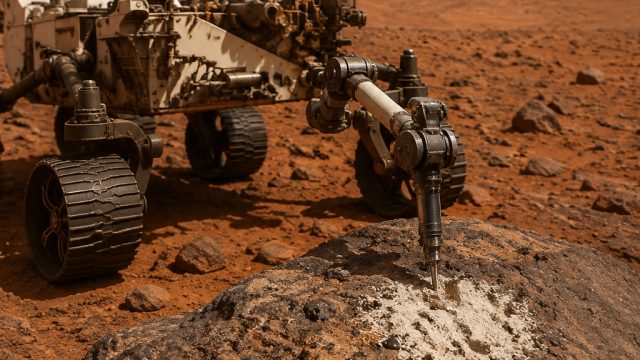
In a groundbreaking development, NASA's Perseverance rover has unearthed organic compounds on the Martian surface, igniting discussions about the potential for ancient life on the Red Planet. This discovery, made in a mudstone area rich in geological history, underscores the significance of ongoing Martian exploration and its implications for astrobiology.
Organic compounds are the building blocks of life as we know it. Their detection on Mars serves as critical evidence of the planet's past environments, which may have been conducive to life. These compounds provide clues about the planet's geological history and the fundamental processes that may have occurred in ancient Martian ecosystems.
The recent findings were reported after the Perseverance rover analyzed rock samples in a region identified as a potentially habitable zone. The mudstone containing organic carbon molecules suggests that Mars once had conditions suitable for life, raising important questions about its biological history.
This discovery from Perseverance is not just a scientific milestone; it also paves the way for future explorations aimed at uncovering more about Mars' past. Future missions will focus on the chemical composition of these organic materials and their possible connections to microbial life.
The search for life beyond Earth hinges on the understanding of how organic compounds are formed and whether they can be linked to biological processes. The prospect of finding such links on Mars is exciting and could reshape our understanding of life's evolution in the universe.
The public response to Mars exploration has been overwhelmingly positive, with many expressing enthusiasm for the possibility that we might one day find definitive evidence of extraterrestrial life. Educational programs and media coverage surrounding Mars missions have fueled interest in science and technology careers among young people.
The detection of organic compounds by the Perseverance rover underscores the urgency and importance of Mars exploration. As technologies advance and new missions are planned, understanding Mars' geological past will not only answer questions about potential life but also inspire a new generation of scientists and explorers. The implications of these discoveries extend beyond our solar system and into the field of astrobiology, offering a glimpse into the possibilities of life elsewhere in the universe.
Stay tuned for future updates on this remarkable journey, as NASA continues to unveil the mysteries of Mars and what they may mean for humanity.
Contact
Stay updated with our latest product releases and news articles. XX Industrial Equipment Co., Ltd. is an emerging enterprise specializing in environmental protection... How can we help you?
Click below — we are happy to help. Contact